BaaS or In-House Infrastructure: How to Decide
Read in Portuguese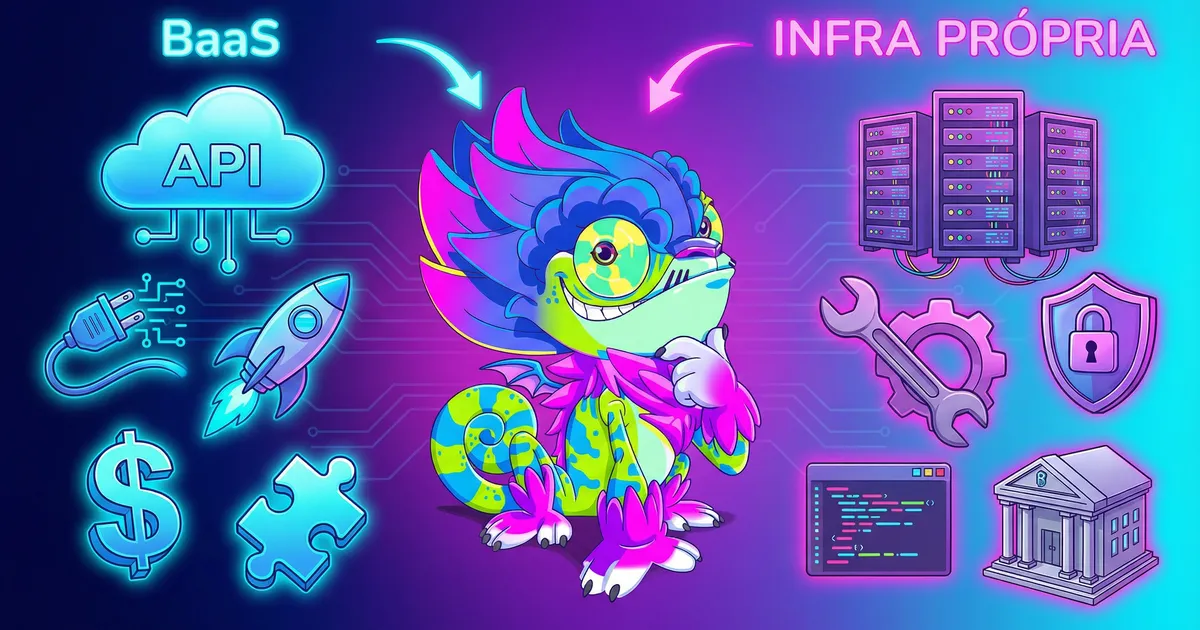
The Banking-as-a-Service market in Brazil is expected to reach approximately $2 billion by 2030, according to projections by Grand View Research. The model has established itself as the primary means of accessing financial infrastructure for companies that are unwilling or unable to obtain their own license. But the landscape that enabled this growth is changing.
Joint Resolution No. 16/2025, published by the Central Bank in November, established a new regulatory framework for the sector. Among the key changes are the requirement for exclusivity by account type; the provider institution’s full liability for the borrower’s transactions; and compliance deadlines extending through December 2026.
In practice, this means that the cost of operating a BaaS arrangement has increased. Providers need to invest more in auditing, monitoring, and governance of their partners. This cost will be passed on. At the same time, the exclusivity requirement reduces flexibility for borrowers who previously diversified among different partners.
In light of these changes, the decision on which infrastructure model to adopt has become more complex. There is no single answer, but it is possible to map out different scenarios.
When BaaS Still Makes Sense
The model remains a valid option for companies that are testing financial products and are not yet clear on the size of the opportunity. It also makes sense for businesses where financial services are complementary to the core business and the transaction volume does not justify investing in their own infrastructure.
However, it is important to note that access to BaaS has become more restricted. With increased liability, providers tend to be more selective about whom they accept as partners. Smaller companies or those with less predictable revenue may find it difficult to secure contracts under the terms that existed before regulation.
When Seeking Greater Control
For companies where financial services are a central part of their value proposition, dependence on a BaaS partner represents a strategic risk. The development roadmap is tied to the provider’s priorities. Customization is subject to contractual and technical limitations. And the exclusivity imposed by the new regulations eliminates the possibility of diversifying suppliers.
In such cases, there are two paths. The first is to apply for a license from the Central Bank, either as a payment institution or under another category. This path requires regulatory capital, a specialized team, and the capacity to sustain ongoing compliance operations. It is viable for companies with scale and long-term ambitions in the financial sector.
The second path is a hybrid model: maintaining the license with a regulated partner while taking control of the technology infrastructure. Core banking and ledger solutions allow the company to manage its own database, define its architecture, and have autonomy over the product. Regulatory dependence remains, but technological dependence decreases.
What to Consider in the Decision
Three variables are central to this analysis. The first is transaction volume. There is a point at which the fixed cost of maintaining one’s own infrastructure becomes lower than the variable cost of a BaaS arrangement. Identifying this point is critical.
The second is strategic relevance. If the ability to innovate in financial products is a competitive advantage, outsourcing the infrastructure limits that ability. Whoever controls the technology controls the speed of product evolution.
The third is execution capability. Maintaining in-house infrastructure requires a team, governance, and capital. Not every company is ready for this, and underestimating this complexity can be more costly than remaining in a BaaS arrangement.
The BaaS market isn’t going away. But the profile of its users and the conditions for access are changing. For those evaluating their financial infrastructure strategy, the current moment calls for a more careful analysis than was necessary two years ago.
Maísa Amaral is a co-founder of Lerian and was part of the founding team at Dock, where she structured the legal and regulatory operations of the fintech company that went on to become one of Brazil’s leading unicorns.